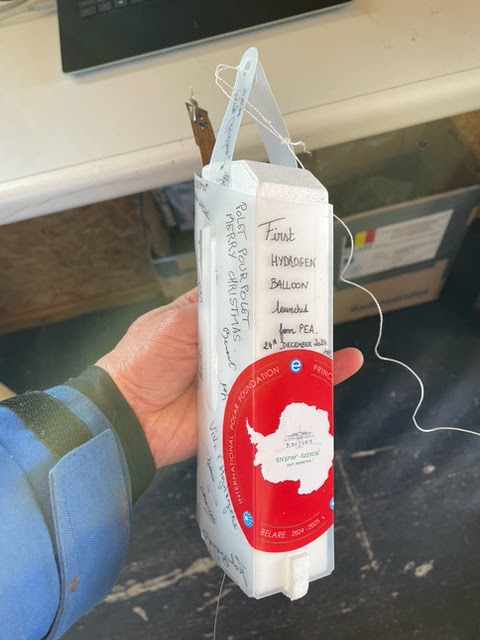
This season at Princess Elisabeth station has started. The station team members arrived by mid-November and opened it. The station has been powered whole winter with no interruption and remote access has always been possible. Therefore we have now a new set of total particle number concentration continuous since January 2025, and the instrument is still running fine.
This season we will have one member of the Paspartout project at the station, from around 20 December 2025 to mid-January 2026. The installations for sampling the chemical composition of the atmosphere have to be checked, samples taken and secured, and some installations will be de-installed and shipped back to Belgium, due to the nearing end of the project in spring 2026. The radiosoundings have been restarted on 17 November with a schedule of each Monday, Wednesday and Friday. Below is a plot of the sounding on 19 November 2025, showing higher winds around an inversion layer at around 3000 m altitude, high winds around the tropopause, and a rather humid troposphere. The station team installed also our ozone spectrophotometer which measures uv spectra and the total ozone column. This years Antarctic ozone hole is on the low side. However, currently the stratospheric air mass with low ozone is located more or less above Dronning Maud Land, the region of Princess Elisabeth station, with moderately low total ozone values around 240 DU. It means that the uv index is bit high. But compared to earlier years, still moderate. Below the uv index graph for 23 November is given.
This season we will also start a new project, in collaboration with our colleagues of the Space Aeronomy institute. We will do reference ground-based total ozone measurements with three instruments: our Brewer ozone spectrophotometer, the Pandora instrument, and the BTS solar instrument. The objective of the project is to test the three instruments, also during austral winter, and to show the instruments ability to deliver high quality measurements in rough environmental conditions, enabling satellite and model data evaluation for Antarctica. In a coming post, I'll describe this project in more detail.

graph for the radiosounding on 19 November 2025