Tuesday, 25 November 2025

Belare season 2025-2026

This season at Princess Elisabeth station has started. The station team members arrived by mid-November and opened it. The station has been powered whole winter with no interruption and remote access has always been possible. Therefore we have now a new set of total particle number concentration continuous since January 2025, and the instrument is still running fine. 

This season we will have one member of the Paspartout project at the station, from around 20 December 2025 to mid-January 2026. The installations for sampling the chemical composition of the atmosphere have to be checked, samples taken and secured, and some installations will be de-installed and shipped back to Belgium, due to the nearing end of the project in spring 2026. The radiosoundings have been restarted on 17 November with a schedule of each Monday, Wednesday and Friday. Below is a plot of the sounding on 19 November 2025, showing higher winds around an inversion layer at around 3000 m altitude, high winds around the tropopause, and a rather humid troposphere. The station team installed also our ozone spectrophotometer which measures uv spectra and the total ozone column. This years Antarctic ozone hole is on the low side. However, currently the stratospheric air mass with low ozone is located more or less above Dronning Maud Land, the region of Princess Elisabeth station, with moderately low total ozone values around 240 DU. It means that the uv index is bit high. But compared to earlier years, still moderate. Below the uv index graph for 23 November is given. 

This season we will also start a new project, in collaboration with our colleagues of the Space Aeronomy institute. We will do reference ground-based total ozone measurements with three instruments: our Brewer ozone spectrophotometer, the Pandora instrument, and the BTS solar instrument. The objective of the project is to test the three instruments, also during austral winter, and to show the instruments ability to deliver high quality measurements in rough environmental conditions, enabling satellite and model data evaluation for Antarctica. In a coming post, I'll describe this project in more detail. 

 graph for the radiosounding on 19 November 2025

graph for the uv index for 23 November 2025


Wednesday, 12 February 2025

Belare season 2024-2025

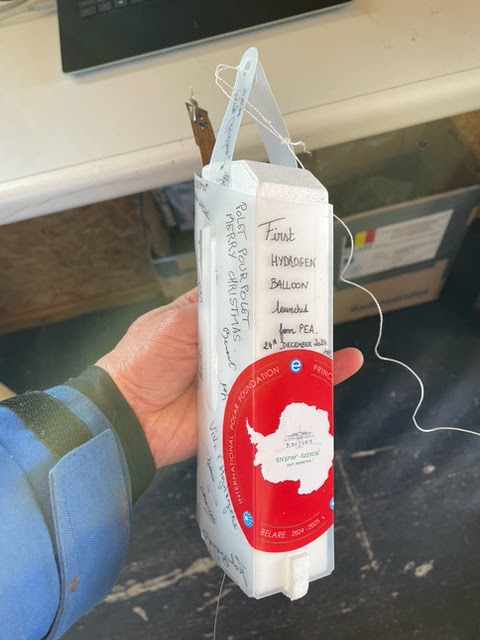
The Paspartout project has been present at Princess Elisabeth Station during Belare 2024-2025. Our team member Paula Lamprea of Ghent University has been at the station from 11 January to 14 February 2025. She managed to complete all tasks. Below there is a short report by her on this work. This Belare season was very successful. Besides Paula's work near the coast, she re-installed the total particle number concentration counter at the station. This instrument is very sensitive and can measure also very very low particle numbers, but also high concentrations. It gives a good view on atmospheric processes going on. Our Brewer ozone spectrophotometer has also been re-installed and maintained. This season has seen no exceptionally large ozone hole (luckily). But because fhe future evolution of stratospheric ozone remains uncertain, ground-based ozone reference measurements like the ones at the station, will continue to be essential for evaluating the impacts of the Montreal Protocol, climate change, and related shifts in atmospheric chemistry, such as those caused by major wildfires. Another important step forward has been that the station operator acquired an hydrogen generator. The hydrogen produced by wind and solar energy has been used for filling the meteorological balloons for radio soundings. This self-produced hydrogen will replace the helium used up to now and it replaces also the costly and heavy shipping of the helium bottles. More about the station can be found here.

The first radiosonde lifted up by green-hydrogen at PEA

The radiosounding profile with the first official hydrogen balloon at PEA


Friday, 19 January 2024

Expedition report of our colleagues at the station

During the austral summer season 2023-2024, two colleagues from Université Libre de Bruxelles (ULB), Sibylle Boxho, and from Ghent University (UGent), Paula Lamprea, will undertake an expedition to the Princess Elisabeth station (PEA) as part of the PASPARTOUT project. This project, financed by the Belgian Science Policy Office (BELSPO), aims to gain an in-depth understanding of the links between atmospheric circulation patterns, weather regimes, particles, volatile organic compounds (VOCs) and moisture, along with their implications and changes within a changing global climate. Follow this link, to their stories about their activities in Antarctica.

Sunday, 19 November 2023

and again a new season at PEA

 Since a bit more than a week, Princess Elisabeth station is open again. The first team around Alain Hubert arrived and has been busy with putting back the station in operational mode for summer season. On the website of the station you can follow the general activities. 

Last week, the first radio soundings with weather balloons have been done again. See the first image below. The jet stream in the upper troposphere was particularly strong (almost 60 m/s) and wind peaked in the stratosphere around 26 km altitude again. It means that the polar vortex was situated above the region of PEA. This year, the ozone hole over Antarctica seems to last again longer than usual (see here).  Since last week, the station team set up again our ozone spectrophotometer which measures UV radiation and the total atmospheric ozone column. From the second graph below, you can see that the UV index reached around local noon bit above 11, meaning that non-protected skin get hurt within 10-15 minutes. This is a direct effect of the reduced total ozone (around 160 DU) due to the ozone hole. 

This season we will also be back at the station with two people from our PASPARTOUT project. We will keep you updated on this blog of the related activities. 


Tuesday, 28 February 2023

Short clip of our activities at the station

We made a short clip showing our instruments and activities at the Princess Elisabeth station. The clip can be viewed here:


It can also be found on Instagram, Twitter and Facebook:


Tuesday, 6 December 2022

Season 2022 - 2023 at Princess Elisabeth has started

The austral season at Princess Elisabeth has started since a few days. It will mainly be a maintenance season and no personnel from our science projects will be there this time. The team at the station will nevertheless take care of our instrumentation. In particular of interest will be how the instruments at the remote site in the mountains have survived - far away from the station and thus only powered by a small wind turbine, a solar panel and some batteries. We will keep you posted on it. 

In the meantime, there has been the first radio sounding of this season on 30 November 2022. On the plot below you can see the high wind in the stratosphere above 20 km height, indicating that the polar vortex was situated above the station. This time the ozone hole is not exceptional (see also the copernicus monitoring). However, still large enough for low total ozone at this time and therefore elevated uv radiation. This caused extreme uv conditions with the UV index rising around local noon above 10, see image below.

season's first radio sounding on 30 November 2022


UV index on 1 December 2022; with extreme values around local noon

Tuesday, 18 January 2022

Tonga volcano eruption pressure wave visible in our recordings

On Saturday 15 January, a volcano erupted near Tonga, with devastating effects. The immense eruption catapulted ash, particles and gases apparently deep into the stratosphere, with estimates up to 30 km height. Besides the disastrous impact on humans, the environment, infrastructure, the eruption sent also a pressure wave around the world, detectable by measurements of atmospheric pressure (e.g., in Belgium). We can even detect this signal in the recordings of the atmospheric pressure inside our nephelometer, running at Princess Elisabeth station - see image below. The eruption took place around 4am UTC (or 5pm local time Tonga). The pressure wave took around 9 hours (for the around 17000 km to the station. A first variation of the pressure of about 2 hPa was detected at 13 UT and a second one of about 1hPa at 15 UT (one wave took the one way around the globe, the other one the other way round).  


Monday, 13 December 2021

Andy and Preben arrived at the station

 After ten days of quarantine in Cape Town, Andy and Preben landed in the evening of 9 December at Perseus air strip, around 60 km from Princess Elisabeth station. After unloading and the trip to the station, they arrived in the very early morning hours at the station. They already checked a lot of our instrumentation. You can follow their activities on our project web page.

Wednesday, 24 November 2021

Inside the polar vortex

 Since Friday 19 November, the team at PEA is launching every second day a weather balloon with a radiosonde for measuring the vertical profile of temperature, relative humidity, wind and pressure. At the moment, the Antarctic ozone hole has started to be 'filled up' again.  However, yesterday's radio sounding happened inside the Antarctic polar vortex, with very high wind speeds between 15 and 20 km altitude, strong westerly winds and low temperature - as can be seen on the graph below (note however, that the humidity values above around 10 km are only indicative).  Total ozone was also very low respectively, with values between 150 and 200 DU. 


Tuesday, 16 November 2021

Season 2021-2022 at PEA has started

Last week, the first technical team arrived at Princess Elisabeth station Antarctica. They have been busy to put the station back into operational mode. Since yesterday, 15/11/2021, the Brewer ozone spectrophotometer is installed again and can monitor the total ozone amount in the atmospheric column. This year's ozone hole is again very important (see here). The first measurements of our Brewer instrument revealed values between 131 and 170 DU. These are very low values, but could be expected due to the still lasting ozone hole over the Antarctic continent. 

This season, two of our research colleagues, Preben and Andy, will travel to the station. Their planned flight from Cape Town, South Africa, to Antarctica is on 7 December. We will keep you updated on this blog on the activities during this season.

Wednesday, 23 December 2020

Blog update by Preben

 On our CHASE project website you can find two new blogs and images of the current season: link


the future site where instrumentation will be installed in order to measure information on VOCs, meteorology, precipitation and particles

Thursday, 17 December 2020

Interview with Alexis, our colleague of BIRA-IASB at the station

 On the webpage of our neighbour institute and partner in research projects CLIMB and Aerocloud, you can find an interview with Alexis Merlaud:  link

Wednesday, 9 December 2020

First radiosounding on 1 December

On 1 and 3 December, Preben and Alexis launched weather balloons with radio sondes, for measuring the vertical profiles of temperature, pressure, humidity and wind. Below, a plot of the first sounding is shown. The very low temperatures between 10 and 15 km of about -70°C are exceptional for this time of the year and are another sign of the long-lasting and huge ozone hole of this year (see also here)

We keep you updated also on the special campaign page of our CHASE project 


Friday, 27 November 2020

Finally, a new season at Princess Elisabeth has started

 Yesterday, 26 November, the first team of the Belgian Antarctic research expedition (BELARE) has arrived at Princess Elisabeth station. They will now by busy to put the station into full operational state. We will keep you updated on the progress and on the activities of our research there. This season, two colleagues are there: Preben Van Overmeiren of Ghent University and Alexis Merlaud of the Belgian Institute of Space Aeronomy. They will work on the CHASE and CLIMB projects and will also maintain the existing instrumentation of the atmospheric observatory.

Thursday, 19 November 2020

Ozone hole over Antarctica

 This year's ozone hole over the South Pole region reaches immense dimensions. The minimum temperature at 50 hPa is still below -75°C, below the level when polar stratospheric clouds can form. This is unique for this time of the year. Also, the absolute minimum of the total ozone column is still below the record years. And forecasts are not showing rapid improvements. It means that levels of UV radiation reaching the surface in these southern regions are very high and respective protective measures are needed. U-to date information can be found on the website of the Copernics Atmospheric Monitoring Service (CAMS) for the ozone layer monitoring

ozone hole area as by 18/11/2020 - copernicusECMWF


Monday, 19 October 2020

RMI presents new report on (Belgian) climate

 On 15 October 2020, the Royal Meteorological Institute of Belgium has published his new report on climate. The report details the results of the most recent observations and of RMI's research on climate. The report aims to inform the scientific community, authorities and the general public on the current state of knowledge of the present and future climate in Belgium.  The report can be downloaded and is availabe in French and Dutch

Friday, 24 April 2020

Global strike for climate 24 April 2020

Although the COVID-19 serious crisis, the global climate challenge might not be forgotten. This Friday, there are several actions, for instance a livestream (youtube) and a webinar of climate experts Jean-Pascale van Ypersele and Sara Vicca and an online strike, organised by the Belgian klimaatcoalitie.  Information can be found on their website and their facebook page.

Monday, 17 February 2020

Short movie on CHASE

Nadine Matielli, Professeur in Gelogoy at ’ULB, presents in 'PITCH', an emission of TV and radio channel BX1, results of the Antarctic expedition, how particles samples have been taken and how they are analysed. You can watch the short movie here

Tuesday, 19 November 2019

A new season starts at Princess Elisabeth Antarctica

A new summer season with a Belgian Antarctic Research expedition (BELARE) is about to start. On 18 November, Stefania Gili and Preben Van Overmeiren left from Brussels in order to travel to the Belgian research station Princess Elisabeth in Antarctica. If weather conditions allow, they will arrive on 21 November at the station. They will stay until around 20 December 2019 in Antarctica. On our blog-subpage links to several blogs can be found where updates on the ongoing expedition will be posted.  You can also follow the general activities at Princess Elisabeth at the station website. On the Twitter account of Stefania you can also follow their activities. 
view to the Southeast from the station

Wednesday, 20 March 2019

Video on the CHASE Belare 2018-2019 campaign

Stefania Gili from the ULB made a video showing what she and Preben have done during their stay for CHASE at Princess Elisabeth station, explaining also how samples are collected and what will happen with them. Enjoy the video here.